
Local SEO for Roofing Companies: Why You Rank at the Office and Vanish Three Miles Out
The map pack isn't one ranking. It's a different ranking at every address a homeowner searches from — and most local SEO for roofers only ever improves the one you're standing on.
Ask a roofing contractor where they rank on Google Maps and you'll usually hear "number one." What they mean is number one at the office. Drive four miles toward the neighborhood they actually want to work in, search the same term, and the profile is gone.
This page explains why that happens, what Google actually uses to rank the local pack, and what it takes to expand visibility across a service area rather than a street. There's a simulator below so you can see the effect for yourself.
What AI Search Optimization Actually Is
It goes by several names. Answer Engine Optimization, AEO, Generative Engine Optimization, GEO, LLM optimization. They describe the same work: making your roofing company the business an AI assistant names when somebody asks it a question.
How it differs from the SEO you already know
Traditional roofing SEO competes for a position in a list of links. A homeowner scrolls, compares, clicks. AI search skips that entirely — the assistant reads the web, decides who to recommend, and returns two or three names.
There is no page two. There is no scrolling past the competition. You are either in the answer or you are not mentioned at all.
The practical consequence: the ranking factors overlap but they are not identical. Backlinks and keyword targeting still matter because AI models read the same web Google indexes. But structure matters more, consistency of your business information matters more, and answering real questions in plain language matters far more than it does for a blue link.
READY FOR YOUR GOOGLE MAPS SEO RANKINGS TO GO THROUGH THE ROOF?
SEO for Growth Top Rated Roofer SEO badge awarded to CinchLocal
AS SEEN IN





Why the Map Pack Works Differently Than Organic Search
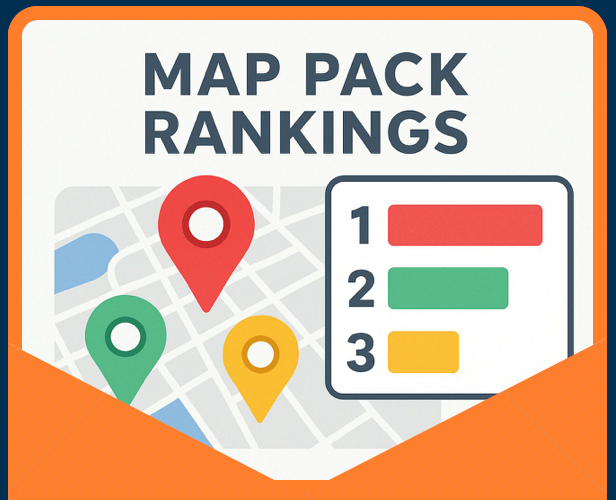
Local SEO for roofing companies is the work of ranking in Google's map pack — the three business listings shown above the organic results for local searches. Google ranks those three on relevance, distance and prominence. Unlike organic search, the map pack is recalculated against each searcher's location, which is why a roofing company can hold first position at its own address and not appear at all four miles away.
Organic search has one result page per query. Everyone searching "roof repair near me" from the same city gets broadly the same blue links. The
map pack does not work that way. Google recalculates the local three against the searcher's position every single time, so a homeowner two towns over sees a different set of roofers than the one across the street from your yard.
For roofing this matters more than for almost any other trade. You aren't waiting for customers to drive to you — you're driving to them, across a service area that might span thirty miles and five towns. Your revenue lives in the places where your map pack position is weakest, and those are precisely the places you never check.
Most local SEO for roofers never addresses this. It optimizes the Google Business Profile, fills in categories, adds photos, and calls the job done. That work is necessary and it is not sufficient — it improves how you rank where you already rank. It does very little for the towns at the edge of the radius, which is exactly where a growing roofing company needs to win.
See Where Your Map Pack Visibility Actually Ends
Google names three things it uses to rank the local pack: relevance, distance and prominence. Two of them you can build. Move the sliders and watch what happens to a roofing company's coverage across a service area.
Google builds local results around the searcher, not around you. Tap anywhere on the grid.
This is a simulation. We'll run the real scan on your business — free, and you keep the report.
Get your real GeoGridGoogle weighs proximity, relevance and prominence. Proximity you can't change — prominence is what decides how far from your door you keep ranking. This illustrates that mechanic; it isn't a prediction of your results.

How Google Decides Who Ranks Higher on Google Maps
Google is unusually direct about this. Its own documentation says local results are based primarily on relevance, distance and prominence — and, crucially, that a business further away can outrank a closer one if it looks like a better match. That last part is the entire opportunity, so it's worth sitting with. Distance is the one factor you cannot change; your yard is where your yard is.
But Google explicitly says distance can be overcome. A roofer eight miles out can beat the roofer down the street, if the other two signals justify it. What follows is the short version. For the full walkthrough, see our definitive guide to using Google Maps for roofing.
Relevance: what Google can read about what you do and where
Relevance is how well your profile matches the search. Complete categories and a fully populated services list help, and most roofers have neither — a primary category chosen years ago and four services listed out of the twenty they actually sell.
But the profile alone is a claim. What turns a claim into evidence is a page on your website about that specific service in that specific town. When your profile says you do metal roofing in a town and nothing else on the internet agrees, Google has one weak signal. When there's a real page backing it, corroborated by reviews mentioning the work, the claim becomes something Google can act on.
Distance: the factor you can't change but can outweigh
Distance is measured from wherever the searcher is, not from the centre of the city. This is why your ranking collapses as you move outward and why a single rank check from your desk tells you nothing useful.
Most roofing companies are what Google calls a service-area business — you visit customers rather than having them visit you. That designation comes with its own rules, including how the service area is defined and whether the address is shown at all.
You cannot move your address, and you should not fake one. Creating a listing at an address you don't operate from breaks Google's guidelines for representing your business and puts the whole profile at risk — including the rankings you already have. The legitimate route is to make relevance and prominence strong enough that the distance penalty stops deciding the outcome.
Prominence: how well known Google thinks you are
Prominence is reputation as Google can measure it. Reviews are the most visible input and Google says so directly — more reviews and better ratings improve local ranking. Citations, brand mentions and links feed the same signal.
Review velocity matters as much as review count. A roofing company with 180 reviews that stopped collecting them two years ago looks different from one with 90 that adds four a month. One profile is a record of past work; the other is evidence of a business currently operating.
So local SEO for roofing companies comes down to a straightforward trade. You cannot move your address. You can build enough relevance and prominence that the address matters less — and that is what expands the ring of towns where you appear.
What This Looks Like Measured
Big River Roofing came to us with a website Google could barely read — nine URLs earning impressions across Western Pennsylvania. In the first 84 days after the rebuild, Search Console recorded impressions across 94 URLs, and ten new market pages produced 25,746 impressions in towns the old site did not adequately cover.
We publish the limits alongside the wins, including where the Google Business Profile results were mixed — direction requests rose while calls and website clicks fell. Read the full case study with the measurement notes.
Roofing Company Local SEO Services: What We Actually Do
Roofing company local SEO marketing is not a checklist you complete once. It's a set of signals that has to keep growing, because your competitors' signals are growing too. Five things move the needle, and they work as a system rather than a menu.
Google Business Profile management for roofing companies
Primary and secondary categories chosen against what actually ranks in roofing, services populated in full, service areas defined honestly, photos added on a schedule, Q&A seeded, posts published. GBP management is table stakes — it's where every agency starts and where most of them stop. Our guide to Google Business Profile optimization for roofing companies covers what that work involves in detail.
Service-area pages that make the profile credible
This is the part that moves the outer ring. A city hub with real service pages beneath it tells Google what you do in that town, not just that you're willing to drive there. It's the same architecture behind our roofing website builds, which is why the website and the map strategy aren't separate projects.
Review generation that compounds
Reviews are the most direct prominence signal Google names. We build the request into the job cycle — text and email, timed to completion, with a link that removes friction — so review velocity becomes steady rather than sporadic.
Citations and entity consistency
Name, address and phone consistent across the directories that matter, so third-party sources corroborate the profile instead of contradicting it. Google treats disagreement between sources as a reason for doubt.
GeoGrid measurement, not guesswork
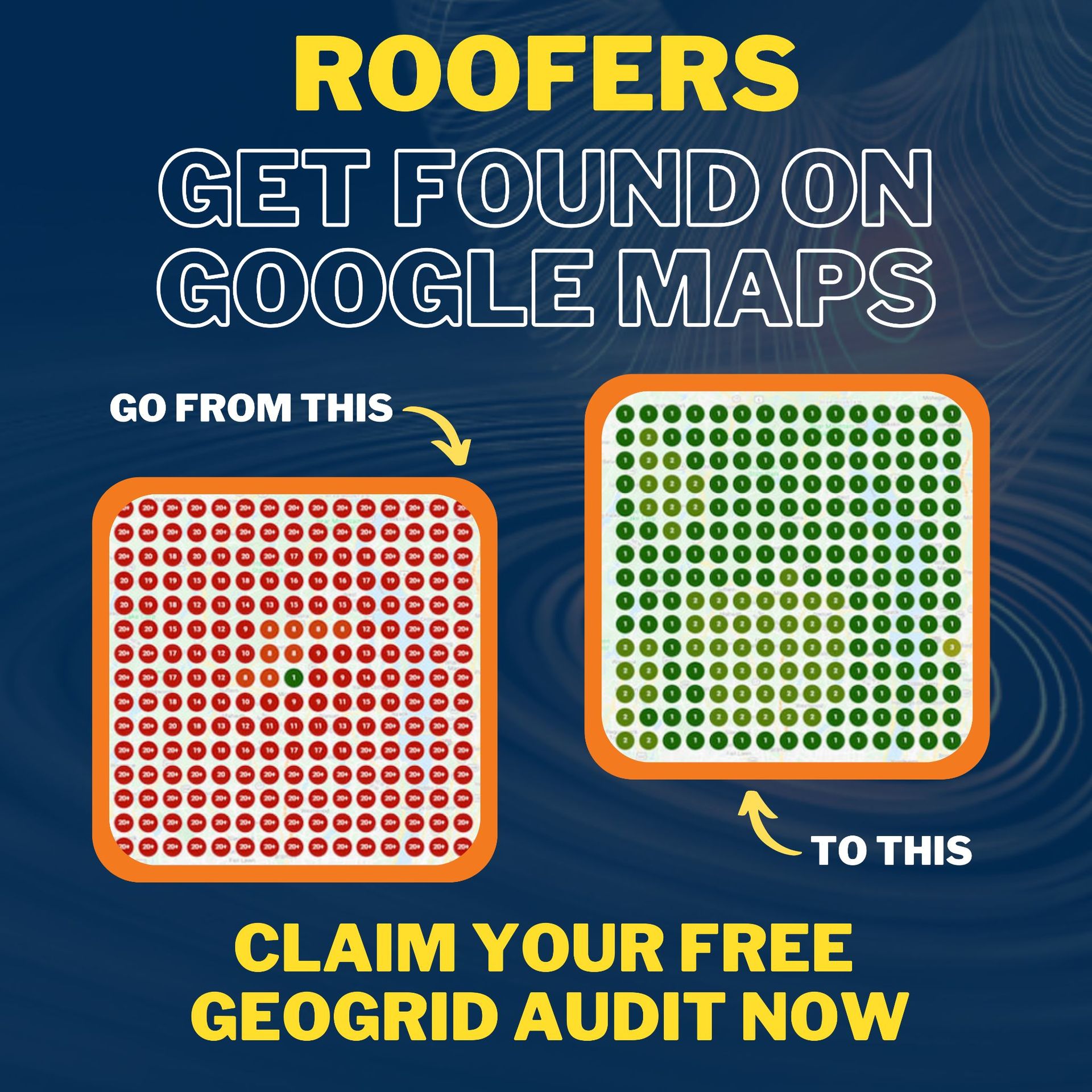
Google Maps optimization for roofing contractors only works if you can see whether it's working. We scan your position across a grid of points throughout the service area, on a schedule, so progress shows up as a map rather than a claim. If the outer ring isn't improving, we find out in weeks rather than quarters. You can see before-and-after GeoGrid scans from real roofing clients on our results page.
Where Map Pack Work Fits in the Footprint Expansion System™ .
Local SEO for roofers rarely works in isolation. The Roofer Footprint Expansion System™ runs Google Maps, organic and AI search visibility as one program, because the same signals feed all three — a service area page that earns a map pack position is also the page that earns the organic ranking and gives an AI assistant something to cite.
If your website can't support that expansion, the map work has a ceiling. That's why most engagements start with the website and add ongoing roofing SEO once the foundation is in place.
Frequently Asked Questions About Local SEO for Roofing Companies
Q: How much should I pay for local SEO?
A: For a roofing company in a competitive market, ongoing local SEO generally runs from the high hundreds to several thousand a month, depending on how many markets you're trying to win and how much of the website work is included. Be wary of anything priced like a subscription with no market analysis behind it — the cost of covering three towns is genuinely different from covering twelve, and a quote that doesn't ask which you need isn't a quote, it's a template.
Q: Is local SEO worth it for a roofing company?
A: Whether local SEO is worth it for a roofing company depends on the market and on patience. Local SEO compounds — visibility you build is an asset you keep, unlike bought leads that stop the day you stop paying, and are sold to your competitors besides. But it takes months, not weeks, and in a market with three entrenched roofers holding the map pack it takes longer. If you need jobs next week, run ads. If you want a position that's difficult to take from you, this is the work.
Q: How do you get into the Google 3-pack for roofing searches?
A: The three-pack is decided by relevance, distance and prominence together. In practice that means a complete Google Business Profile with the right categories, a website with a real page for the service and town you want, review volume competitive with whoever holds the positions now, and consistent business information across directories. There's no single lever — roofers who get in usually improved all four at once.
Q: How long does local SEO for a roofing company take to work?
A: Expect three to six months before map pack position moves meaningfully across a service area, and longer in competitive metros. Profile improvements can show up within weeks. Expanding into towns where you have no address takes longest, because that depends on service-area pages and review volume building over time. Anyone promising map pack dominance in 30 days is guessing.
Q: Can a roofing company rank in a city where it has no office?
A: A roofing company can rank in a city where it has no office, though it is harder than ranking at its own address. Google says distance is one of three primary factors, but also that a more relevant business further away can outrank a closer one. In practice that means a real service page for that town, reviews from customers there, and consistent citations. Creating a fake location in a city you don't operate from violates Google's guidelines for representing your business and risks the entire profile.
Q: What is a GeoGrid scan and why does it matter for roofers?
A: A GeoGrid scan checks your map pack position from dozens of points spread across a geographic area and returns a grid showing where you rank at each one. It matters more for roofing than most trades because your service area is wide — checking your ranking from the office tells you almost nothing about the towns where you actually want jobs.
Q: How many Google reviews does a roofing company need?
A: There is no fixed number of Google reviews a roofing company needs — it is relative to the market. What matters is being competitive with the roofers currently holding the top three in the towns you want, and keeping new reviews arriving steadily rather than in bursts. Google names reviews as a prominence factor directly, and prominence is one of the two levers you can actually pull.
Q: Is Google Business Profile management enough on its own?
A: Google Business Profile management improves how you rank where you already rank, which is worth doing and is where most agencies stop. It does much less for the outer edge of a service area, because the profile is a claim and Google looks for corroboration. Service-area pages, reviews and citations are what let the profile carry weight in towns you have no address in.
Q: Do I need a new website for local SEO to work?
A: A new website is not always required, but a five-page brochure site puts a ceiling on how far the map work can go. If there's no page about roof repair in the town you want to rank in, Google has nothing to corroborate the claim. Some roofers start with map work on an existing site and rebuild later; others do it the other way round. We'll tell you honestly which applies on the call.
Q: What's the difference between local SEO and organic SEO for roofers?
A: Local SEO targets the map pack — the three listings with the map above them, ranked by relevance, distance and prominence. Organic SEO targets the blue links below, where distance matters far less. Roofers need both, and the same service-area pages feed each one, which is why we run them as a single program rather than two.
Q: Do you work with more than one roofer in the same area?
A: Never. CinchLocal works with one roofing contractor per protected area. The visibility we engineer for a client doesn't then get built for the competitor down the road — which matters more in map pack work than anywhere else, because local rankings are zero-sum within a market.
Q: What is the best way to advertise a roofing company?
A: The best way to advertise a roofing company depends on the timeline. Local Service Ads and Google Ads buy visibility immediately and stop the moment you stop paying. Local SEO and the map pack take months but produce an asset you own. Referrals and door-knocking after storms still work and always will. Most roofing companies doing $1M or more run a mix — ads for immediate volume, organic and map visibility so the cost per job falls over time.
Find Out Where You Actually Rank — Not Where You Assume You Do
The simulator above is an illustration. A real GeoGrid scan is not — it measures your actual map pack position at dozens of points across your service area and shows you exactly where the visibility stops.
CinchLocal is a roofing local SEO company and nothing else. Not a generalist agency with a roofing page, not a local SEO consultant who takes roofing clients between dentists — roofing contractors are the entire business. It means we already know which searches produce estimate requests instead of curiosity, and which towns are worth fighting for in your market.
Book a free strategy session and we'll run the scan, walk you through what it shows, and tell you honestly whether your market is worth the investment. You keep the grid either way — and we only take one roofer per area, so it's worth checking whether your city is still open.